The DISC assessment is incredibly popular for a reason: It brings clarity and insight to behavior in an accessible, actionable way.
The way you take and use the assessment can vary on your assessment provider, but there are best practices for using DISC accurately and effectively.
Key Takeaways:
- You should retake DISC once a year or after a major life event.
- Taking DISC more frequently than that gives you less accurate results.
- Don’t throw out your old DISC profiles; use them to guide future development and compare and contrast.
- 12 Driving Forces® (Motivators) change differently than DISC.
- Major life events including marriage, breakups, new jobs, job loss, moving, global events, birth of children, death of loved ones, and more.
When Should You Retake the DISC Assessment?
One of the most common questions I hear in training is, ‘How often should I retake an assessment?’ closely followed by, ‘How often should my clients retake it?’ The answer really depends on where you’re at and where you want to go.
Here are solid guidelines to help you make an informed decision on when you should retake the DISC assessment.
Why Should You Retake DISC?
DISC isn’t about being a ‘type’ or gaining a label. It’s about increasing awareness of behavior.
Think of it like an annual check-up. Retaking the DISC assessment gives you a pulse on your overall well-being, especially how you are showing up behaviorally in both your personal and professional life. It helps answer questions like:
- Am I operating from my natural baseline of behavior?
- Have there been shifts in how I respond to pressure or change?
- Am I adapting my behavior in healthy ways, or just surviving?
While everyone talks about physical wellness, DISC is a powerful tool for checking in on behavioral wellness. It also gives coaches, leaders, and organizations valuable insight to support people more effectively.
How to Time a DISC Retake?
At TTI Success Insights, our team retakes our assessments annually, which is a great standard. It gives you time to reflect on your results and accurately track changes.
We recommend retaking your assessment every 18–24 months, depending on what is happening in your life.
Here are some general best practices:
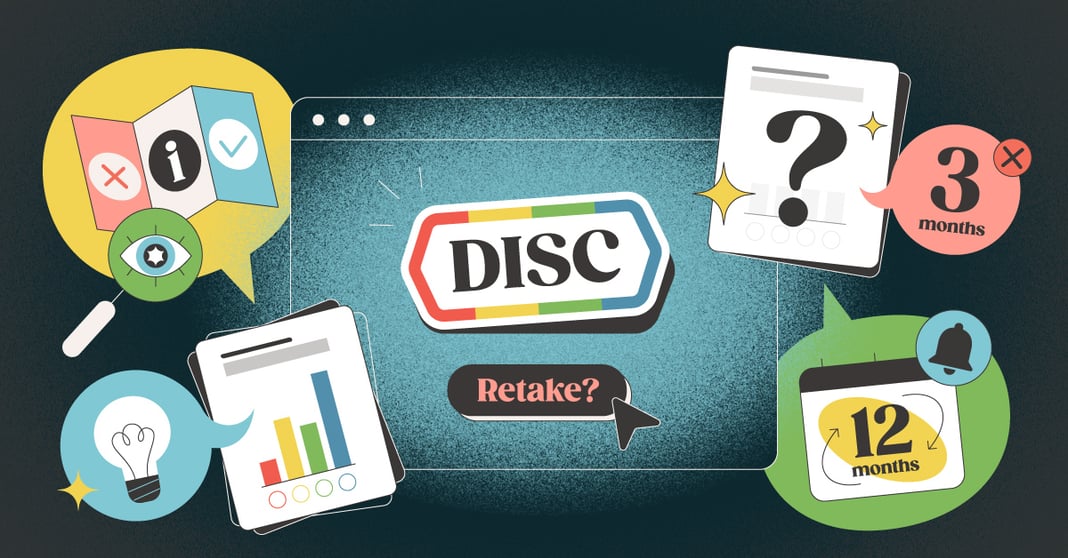
- Do not retake DISC more frequently than every 3 months.
- Retaking DISC once a year is standard.
- Retake DISC after a major life event, even if it hasn’t been a full year.
Life happens. We adapt. Assessments help surface those adaptations.
What Counts as a “Major Event”?
Major events, positive or negative, can significantly impact how we show up behaviorally. These might include:
- Marriage or divorce
- A breakup
- Moving
- Birth of a child
- Death of a loved one
- Starting a new job or role
- A global or external crisis (pandemic, war, economic instability)
Any significant milestone can shift how we respond to the world. DISC helps you understand whether those shifts are temporary adaptations, or something deeper.
Natural Style vs. Adapted Style: Why Changes Matter
At TTI, we measure both Natural and Adapted behavioral styles. Your Natural style tends to stay relatively consistent over time. When I see a significant shift in someone’s Natural graph, it makes me curious to learn more.
I once facilitated a training where a woman’s Natural DISC profile changed dramatically over an 18-month period. In 2022, she was a Reflective communicator with a low D score, making her more patient and reserved. By early 2024, she was a Direct communicator; her Dominance score increased by more than 80 points!
I asked if she was willing to share what had changed in her life.
She told us she had been diagnosed with cancer in late 2023.
Suddenly, decisions had to be made quickly. Waiting was not an option. She needed to act, advocate for herself, and move forward without hesitation. Her behavior shifted because her life demanded it.
What was powerful is that she recognized the change, understood it, and honored where she was in that season. DISC gave her language and awareness, not judgment.
Your Adapted Style will naturally fluctuate, especially under pressure. What matters is noticing why those shifts are happening and approaching them with curiosity.
Remember, behavior is changeable! If you have a low Compliance score, but your position requires a lot of data analysis, you can study the behavioral patterns of a Precise communicator and implement them after time.
What About Driving Forces/Motivators?
Unlike DISC, Driving Forces (Motivators) are expected to change over time, on average, about seven times throughout your life.
Think about it:
- As children, we often adopt our parents’ values.
- As teenagers, we rebel and explore the opposite.
- Then comes college, first jobs, relationships, children, career changes, retirement…
Life evolves, and so do our values.
When I took my first assessment in 2008, my Driving Forces were Resourceful, Instinctive, Commanding, and Objective. Everything was mainstream, except Instinctive, which was Passionate.
Today, my profile is Harmonious, Instinctive, Intentional, and Commanding. I am a 100 in Harmonious, and my Objective score is 0, yet it was a Primary Driving Force for me 18 years ago.
That shift makes me pause and reflect on how much has changed in my life. And honestly, I feel more balanced and grounded today. But who knows where I will be in another 18 years, that is the beauty of growth.
What Should You Do with Old DISC Assessments?
Don’t throw your old assessments away! Use them!
As a coach or leader, comparing a client’s previous report to their current one can unlock powerful insights. TTI’s Comparison Reports allow you to see:
- What stayed consistent
- What shifted
- Where adaptation may be happening
- Where support or conversation is needed
This applies not only to DISC and Driving Forces, but also to other TTI assessments like EQ, DNA, and Acumen. Each retake adds context, depth, and understanding.
Conclusion
Retaking assessments is not about changing who you are, it is about understanding where you are.
For you, your clients, and your well-being.
Assessments give us permission to pause, reflect, and ask better questions. And sometimes, that awareness alone makes all the difference.
Want to experience DISC for yourself? TTI is here to help.